INDUSTRY SERVED: Hospitality
Executive Summary
Envative developed a scalable hospitality IoT platform for Armadillo Hotels Group using AWS IoT Core and cloud-based infrastructure. The system enabled mobile keyless room access, kiosk check-in, housekeeping automation, centralized monitoring, and multi-property operational management.
| Industry | Hospitality / Hotels |
|---|---|
| Solution Type | IoT Hotel Operations Platform |
| Core Technologies | AWS IoT Core, Mobile Applications, Cloud Infrastructure, Access Control Systems |
| Key Features | Mobile Keyless Entry, Kiosk Check-In, Housekeeping Automation, Device Monitoring, Role-Based Access Control |
| Business Goals | Streamline hotel operations, improve guest experience, reduce operational friction, and support scalable deployment |
| Architecture | Cloud-based asynchronous IoT messaging architecture with centralized operational management |
| Outcomes | Improved operational visibility, autonomous guest access, scalable infrastructure, and centralized device management |
Hospitality Technology Challenges
Hotels Often Operate on Disconnected Systems
Hotels frequently rely on separate systems for:
- reservations
- housekeeping
- maintenance
- billing
- guest access
- employee permissions
This creates operational inefficiencies, data silos, and inconsistent guest experiences.
Traditional Hotel Keycards Create Operational Friction
Physical keycards introduce:
- front desk dependency
- lost card issues
- security concerns
- manual provisioning overhead
Hotel Operators Need Scalable Access Control
Modern hospitality brands require:
- centralized permissions
- mobile access
- employee role controls
- audit logging
- remote monitoring
The Client
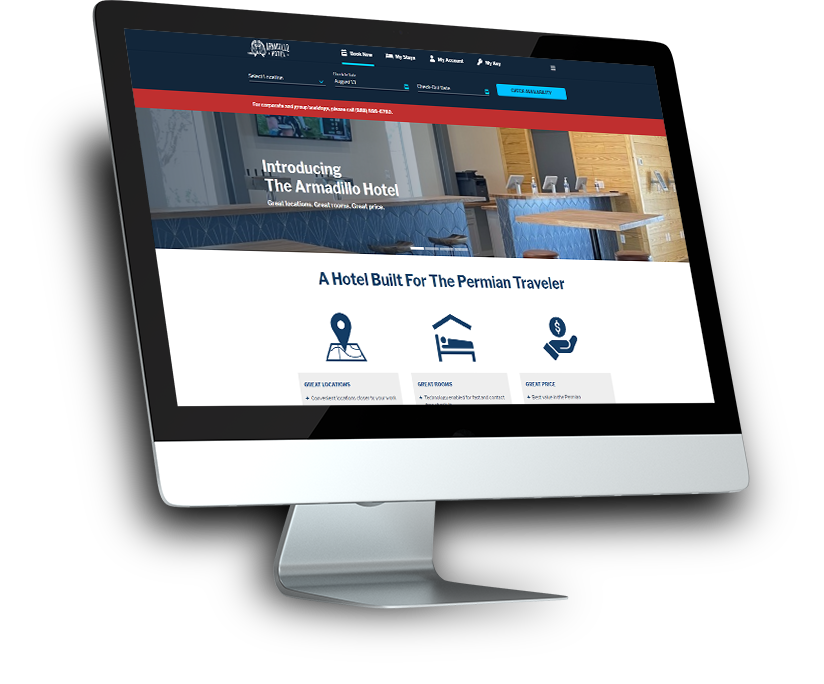
Armadillo Hotels Group was formed with the idea of creating a different type of Hotel chain. One that would better support needs for company bookings and billing for multiple rooms, long-term stays, at an affordable price.
Hotel IoT System Architecture
Core Components
AWS IoT Core
Envative used AWS IoT Core to provision and manage hotel room devices securely at scale.
Mobile Keyless Entry
Guests could unlock rooms through a mobile application without requiring a physical keycard.
Asynchronous Messaging Layer
A message broker architecture enabled secure communication between:
- room devices
- cloud services
- mobile applications
- operational dashboards
Monitoring & Device Health Checks
The system continuously monitored:
- connectivity status
- hardware health
- device reliability
- access activity logs
Key Features
The hospitality IoT platform was designed to streamline hotel operations, improve guest experiences, and support scalable multi-property management through connected systems and cloud-based infrastructure.
Mobile Keyless Entry
Guests can securely unlock hotel rooms using authenticated mobile credentials without relying on traditional physical keycards.
- Digital room credentials
- Reduced front desk dependency
- Improved guest convenience
- Secure access authentication
Kiosk-Based Check-In
Self-service kiosks streamline guest check-in workflows while reducing operational bottlenecks during peak hotel traffic.
- Self-service check-in workflows
- Reduced wait times
- Integrated room provisioning
- Scalable guest onboarding
Challenge
As an outsider, a hotel’s operation appears to be simple—it sells lodging along with food and beverages. But a hotel is a highly complex operation where many departments must function, coordinate and interact together to ensure smooth day-to-day operations.
Armadillo’s vision for a comprehensive, secure, robust, and flexible hotel management software that could streamline operations across all hotel core service areas:
• front office
• housekeeping
• food and beverage
• accounting
• human services
• engineering and maintenance
• sales and marketing
The systems required to support all these functions create a high degree of complexity and integration. This is why, in almost every instance, hotels operate with multiple, disparate systems that do not “talk” to each other, which leads to inefficiencies, errors, customer dissatisfaction and reduced profitability.
This case study focuses specifically on the autonomous room access feature that AHG wanted to provide to its guests. In essence, Envative was tasked with implementing an IOT-enabled mobile, keyless room entry that would allow guests to enter their room without having to first check in at the front desk and obtain a keycard.
Hospitality IoT Platform Architecture
This was a 12-month development project that started with Envative’s time-tested prototyping
phase to ensure that the team understood the features and functionality Armadillo wanted and make sure their expectations would be met. Envative’s web, mobile and IoT development teams all came together to map out the appropriate architecture for scalability and extensibility of Armadillo’s vision.
The teams planned their software delivery phases to include Minimum Viable Product features that could be launched first and then quickly followed by additional functionality in phases. While the teams took a “divide and conquer” approach to the massive project, they didn’t work in a vacuum.
Envative’s strength in technical project management, communication and additional prototyping ensured the teams worked cohesively toward the end goal. In addition, the company’s agile development process allowed each team member to respond to and incorporate feature-scope change requests along the way.AHG's goal was to provide autonomous, secure room and/or common area access for guests as well as employees such as housekeeping and maintenance staff. The access control solution needed to include monitoring, user permission control, reporting and logging of access activities.
AHG wanted to ensure user access would be reliable with safeguards in place to address potential connectivity issues.
In addition, they wanted to make sure the end result would be scalable and cost-effective so that they would could continue to offer their rooms at reasonable rates.
To support these features, Envative selected AWS IoT Core to provision devices for rooms and common areas and used Message Broker to send/receive updates to/from the devices in an asynchronous, secure, and reliable manner. Some of the IoT-enabled support features include:
- Support of housekeeping activities, allowing staff to enter the room when cleaning is required. The application reports back to management on all cleaning activities performed as well as other upkeep and maintenance needs of the room.
- In addition to securing individual room doors, the devices control common areas for guests or employees.
- Monitoring the devices in case of hardware or connectivity issues with a relay of health check information back to AWS.
- Custom CloudWatch metrics and dashboards were developed to monitor the overall health of thousands of devices.
- Access logs are recorded with each entry and stored in AWS DynamoDB
- Access logs include a camera snapshot of the entry attempt, stored in AWS S3.
Why AWS IoT Core?
Envative selected AWS IoT Core to provide the scalability, reliability, and secure device communication required for a modern hospitality IoT platform. The system needed to support real-time interactions between hotel room devices, mobile applications, kiosks, operational dashboards, and cloud infrastructure across multiple properties.
Secure Device Communication
AWS IoT Core enabled secure communication between connected hotel devices and cloud services using authenticated, encrypted messaging. This allowed guest room access systems, kiosks, and operational tools to exchange data reliably while maintaining strong security controls.
Scalable Multi-Property Infrastructure
The platform was designed to support future growth across multiple hotel properties. AWS IoT Core provided a scalable architecture capable of managing increasing numbers of connected devices, users, rooms, and operational workflows without requiring major infrastructure changes.
Real-Time Operational Visibility
The cloud-based architecture enabled centralized monitoring of:
- device connectivity
- room access activity
- operational status
- system health
- communication reliability
This improved visibility for hotel administrators and helped operational teams identify issues more quickly.
Asynchronous Messaging Architecture
Using asynchronous messaging patterns allowed connected systems to communicate efficiently without relying on tightly coupled real-time dependencies. This improved:
- platform reliability
- operational resilience
- scalability
- device coordination
- performance during peak usage
Device Monitoring and Health Checks
AWS services supported ongoing monitoring of IoT devices throughout the hospitality environment. Operational teams could track:
- online/offline status
- communication failures
- device reliability
- access events
- system alerts
This reduced operational blind spots and improved maintenance workflows.
Cloud-Native Hospitality Platform
The platform leveraged cloud-native infrastructure to simplify deployment, centralized management, and future feature expansion. This architecture supported long-term operational flexibility while reducing the complexity of managing distributed hotel systems.
Why It Mattered
For hospitality operations, reliability and usability are critical. Guests expect seamless room access and fast check-in experiences, while hotel staff require dependable operational systems behind the scenes. AWS IoT Core helped provide the secure, scalable foundation necessary to support both guest-facing experiences and internal hotel operations within a unified platform.
Operational and Guest Experience Outcomes
Improved Guest Experience
Guests could bypass the front desk and access rooms directly through mobile authentication.
Reduced Operational Complexity
The centralized platform reduced reliance on disconnected hospitality systems.
Scalable Hospitality Infrastructure
The system was designed to support additional hotel properties and white-label licensing opportunities.
Enhanced Operational Visibility
Management gained centralized monitoring and reporting across rooms and common areas.

"The Envative team is very professional and knowledgeable. They have excellent technical skills, solid project management and have been very easy to work with."
- Lee Eichen, AHG Technologies, LLC
Frequently Asked Questions
What is IoT in hospitality?
IoT in hospitality refers to internet-connected systems used to automate hotel operations such as room access, lighting, housekeeping, monitoring, and guest experiences.
How does mobile hotel keyless entry work?
Mobile keyless entry uses authenticated mobile credentials to communicate securely with smart locks or IoT-enabled access systems.
Why do hotels use AWS IoT Core?
AWS IoT Core helps hotels securely manage connected devices, monitor device health, and scale IoT infrastructure across properties.
What are the benefits of hotel access control systems?
Benefits include:
- improved guest convenience
- centralized permissions
- audit logging
- reduced operational overhead
- improved security
Conclusion
The Armadillo Hotel Group has been very pleased with all aspects of Envative's AWS IOT Access Control implementation. They continue the expansion of their hotel group and rely on Envative as their trusted Software development and AWS solutions partner.
Related Solutions
Explore Envative services related to hospitality IoT, connected device platforms, mobile access, cloud infrastructure, and operational software.

About AHG Technologies
Armadillo Hotels Group was formed with the idea of creating a different type of Hotel chain. One that would better support needs for company bookings and billing for multiple rooms, long-term stays, at an affordable price.
AWS Services Used
- AWS ECS
- AWS CloudFormation
- AWS Lambda
- AWS SQS and SNS
- AWS RDS
- AWS DynamoDB
- AWS Cloud Watch
- AWS IoT Core
Benefits
- Scalable
- Cost-efficient
- Secure